
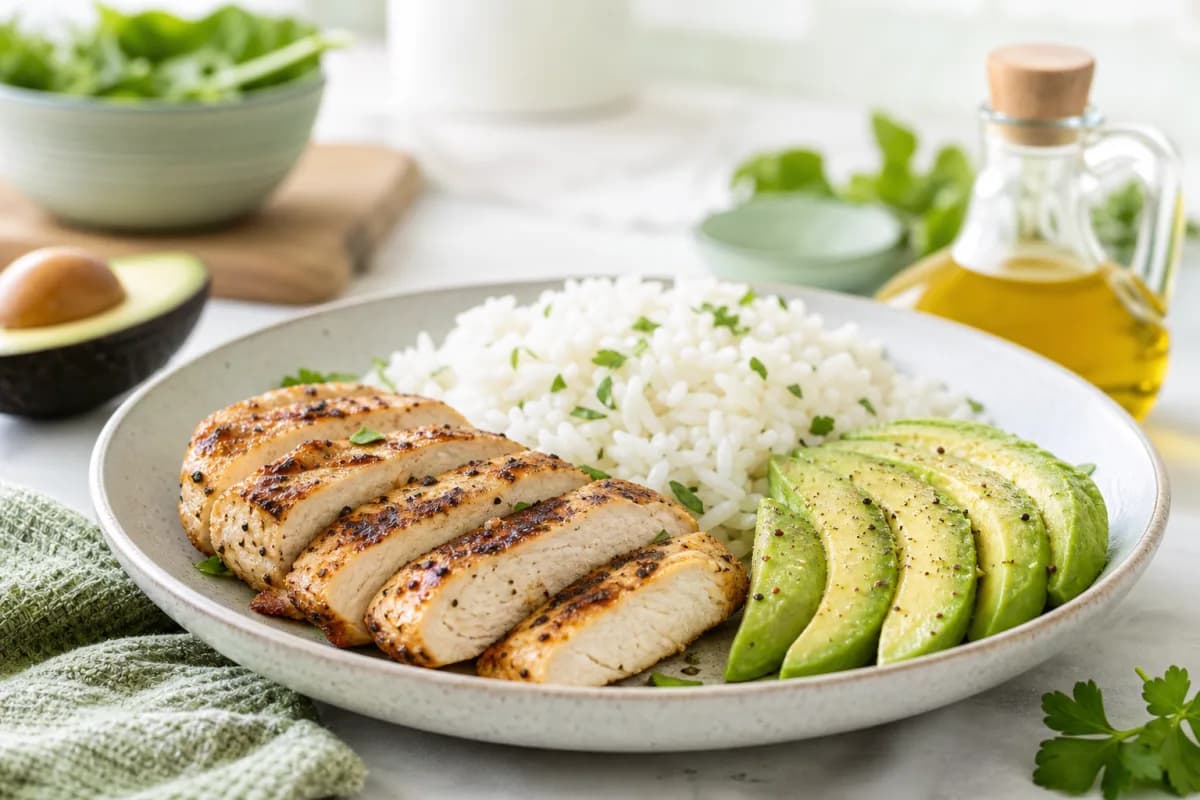
You've heard people talk about "hitting their macros" — as if everyone learned this in school. If you're staring at a label wondering what 150g of protein actually looks like on a plate, you're not alone.
Macro meal planning is one of the most effective frameworks for eating toward a goal — whether that's fat loss, muscle gain, or simply feeling better. This guide breaks down what macros are, how to set yours, and how to plan meals around them without living in a tracking app.
What are macros?
"Macros" is short for macronutrients — the three categories of nutrients that provide calories:
| Macro | Calories per gram | Primary role |
|---|---|---|
| Protein | 4 kcal | Muscle repair, satiety, enzyme production |
| Carbohydrates | 4 kcal | Energy, brain function, training fuel |
| Fat | 9 kcal | Hormones, vitamin absorption, long-lasting energy |
Everything you eat is some combination of these three. Your macro split is how your total daily calories divide across protein, carbs, and fat.
Calories determine weight change. Macros determine how you feel, perform, and look while that change happens.
Why macro meal planning beats "just eating less"
For fat loss, a calorie deficit is non-negotiable — you must consume less energy than you burn. But how those calories are distributed matters:
- Too little protein during a deficit → muscle loss, constant hunger
- Too few carbs while training hard → flat workouts, brain fog
- Too little fat → hormonal issues, dry skin, poor recovery
Macro meal planning ensures your deficit (or surplus) is structured, not random.
How to set your macro targets
Step 1: Find your calorie target
Start with your Total Daily Energy Expenditure (TDEE) — the calories you burn in a typical day including activity. Then adjust for your goal:
- Fat loss: TDEE minus 300–500 kcal
- Maintenance: TDEE
- Muscle gain: TDEE plus 200–300 kcal
Step 2: Set protein first
Protein is the priority macro. Aim for:
- Fat loss: 1.6–2.2g per kg of body weight
- Muscle gain: 1.6–2.2g per kg of body weight
- General health: at least 1.2g per kg
For a 75 kg person targeting fat loss: 120–165g protein daily.
Step 3: Allocate fat
Fat typically falls between 20–35% of total calories. On a 2,000 kcal plan at 25% fat:
- 2,000 × 0.25 = 500 kcal from fat
- 500 ÷ 9 = ~55g fat
Step 4: Fill the rest with carbs
Whatever calories remain after protein and fat go to carbohydrates:
- Protein: 150g × 4 = 600 kcal
- Fat: 55g × 9 = 495 kcal
- Remaining: 2,000 − 600 − 495 = 905 kcal from carbs
- Carbs: 905 ÷ 4 = ~225g
That's your macro split: 150P / 225C / 55F.
How to build macro-friendly meals
You don't need to hit exact numbers at every meal. Focus on daily totals and use simple meal structures:
The protein-first plate
Build every meal around a protein source, then add carbs and fat:
- Protein — chicken, fish, eggs, tofu, Greek yogurt (palm-sized portion)
- Carbs — rice, pasta, bread, fruit (cupped-hand portion)
- Fat — olive oil, nuts, avocado, cheese (thumb-sized portion)
- Vegetables — fill half the plate, minimal calorie impact
Sample macro-balanced day (2,000 kcal / 150P / 225C / 55F)
- Breakfast: Greek yogurt, berries, granola (~400 kcal, 25g protein)
- Lunch: Chicken rice bowl with vegetables (~600 kcal, 45g protein)
- Snack: Apple + peanut butter (~250 kcal, 8g protein)
- Dinner: Salmon, roasted potatoes, salad with olive oil (~750 kcal, 55g protein)
Common macro meal planning mistakes
- Chasing perfection — within 5–10g daily is fine; don't stress 1g over
- Ignoring protein at breakfast — front-loading protein reduces hunger all day
- Cutting fat too low — below 0.5g/kg body weight causes problems
- No planning — macros without a meal plan = nightly guesswork
- Tracking forever — use tracking to learn portions, then transition to structured meals
Macro meal planning without the spreadsheet
Once you know your targets, the hard part isn't the math — it's building meals that fit, every day, all week.
That's where a macro meal plan tool like NoroMeal helps: set your profile once, get daily targets and matched recipes automatically, and follow the plan instead of logging every bite.
NoroMeal calculates your calorie and macro targets and builds a weekly meal plan with recipes that fit — so you eat toward your goals without the spreadsheet.