
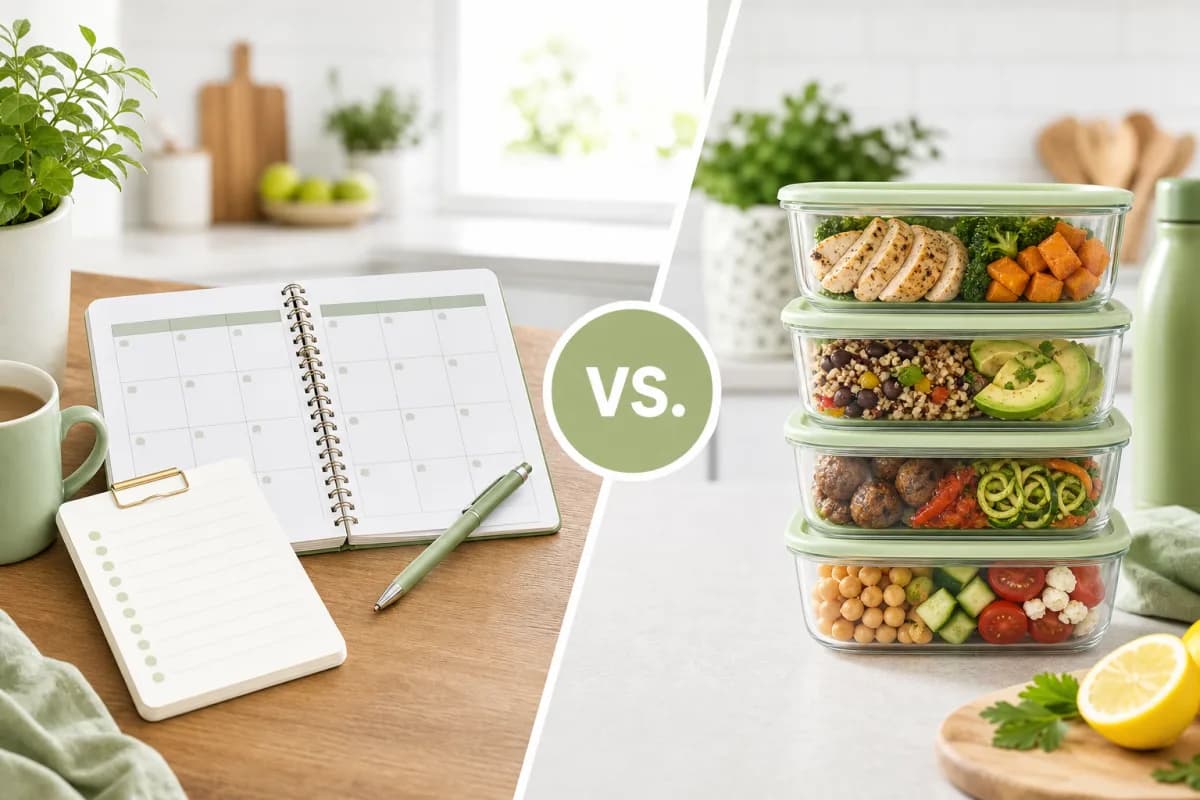
People use "meal planning" and "meal prep" interchangeably — then wonder why they're exhausted after a five-hour Sunday in the kitchen.
They're related, but they're not the same thing. Understanding the difference saves you hours, reduces food waste, and makes it far more likely you'll actually stick to your nutrition goals.
Meal planning: deciding what to eat
Meal planning is the thinking work. It answers:
- What am I eating this week?
- Does it fit my calorie and macro targets?
- What do I need to buy?
- Which nights need quick meals vs. more time?
Meal planning produces a weekly menu and grocery list. It requires a pen, a spreadsheet, or a meal planning app — not necessarily a stove.
Meal planning is strategy. Meal prep is execution.
Meal prep: preparing food in advance
Meal prep is the cooking work. It means preparing some or all of your meals ahead of time — usually on Sunday — so they're ready to grab during the week.
Common meal prep outputs:
- Portioning cooked chicken and rice into containers
- Chopping vegetables for the week
- Making a batch of chili or soup
- Pre-packing snack bags
Meal prep saves time during the week at the cost of time on prep day.
The key differences at a glance
| Meal Planning | Meal Prep | |
|---|---|---|
| What it is | Deciding what to eat | Cooking ahead |
| When | Once a week (30 min) | Once a week (1–4 hours) |
| Output | Menu + grocery list | Ready-to-eat containers |
| Requires cooking? | No | Yes |
| Reduces decision fatigue? | Yes | Yes |
| Reduces cooking time daily? | Indirectly | Directly |
You can meal plan without meal prep
This is the insight most busy people miss: a meal plan doesn't require pre-cooked containers.
You can plan your week, shop once, and still cook fresh each evening — in 15–20 minutes — because you already know what you're making and have the ingredients.
For many people, this is the sweet spot:
- Sunday: 30 minutes planning + one grocery trip
- Weeknights: 15 minutes cooking from the plan
- No fridge full of identical containers you dread eating by Thursday
You can meal prep without a real meal plan
The opposite failure mode: spending four hours cooking without a plan.
You end up with:
- 8 identical chicken-and-rice containers you get sick of by Wednesday
- No alignment with your calorie or protein targets
- Food waste when plans change mid-week
- Burnout and abandonment of the whole system
Meal prep without meal planning is just batch cooking — useful, but not a nutrition strategy.
Which approach is right for you?
Choose meal planning only if:
- You prefer fresh-cooked meals
- You have 15–20 minutes most evenings
- Your schedule varies and pre-prepped food goes to waste
- You want flexibility within structure
Add meal prep if:
- Your evenings are completely packed
- You eat lunch at the office with no kitchen
- You know you'll order takeaway without grab-and-go options
- You don't mind eating similar meals 3–4 days in a row
Combine both (the power approach):
- Plan the week — menu, targets, grocery list (30 min)
- Prep selectively — only the meals that need it (45–60 min)
- Cook fresh for dinners when you have time
Selective prep examples:
- Hard-boil eggs for breakfast all week (10 min)
- Cook a batch of rice or quinoa (20 min)
- Portion lunches only (Mon–Wed)
- Wash and chop vegetables (15 min)
- Leave dinners as quick fresh cooks
The minimum viable system for busy people
If you're starting from zero, do this:
- Plan 5 dinners and 3 lunches for the week
- Shop once from a single list
- Prep one thing — rice, eggs, or chopped veg
- Cook dinner fresh in 15 minutes using the plan
- Repeat next week with 1–2 new meals swapped in
Total time: under 90 minutes per week — not five hours.
Let NoroMeal handle the planning part
The hardest step isn't chopping vegetables — it's deciding what to eat, in what portions, every day, all week.
NoroMeal generates your weekly meal plan with calorie and macro targets and matched recipes — so you know exactly what to shop for and cook, whether you meal prep or cook fresh.
Handle the strategy automatically. Spend your time on the parts you enjoy.